The Invoice Detail folder contains the detail lines for your AR invoices.
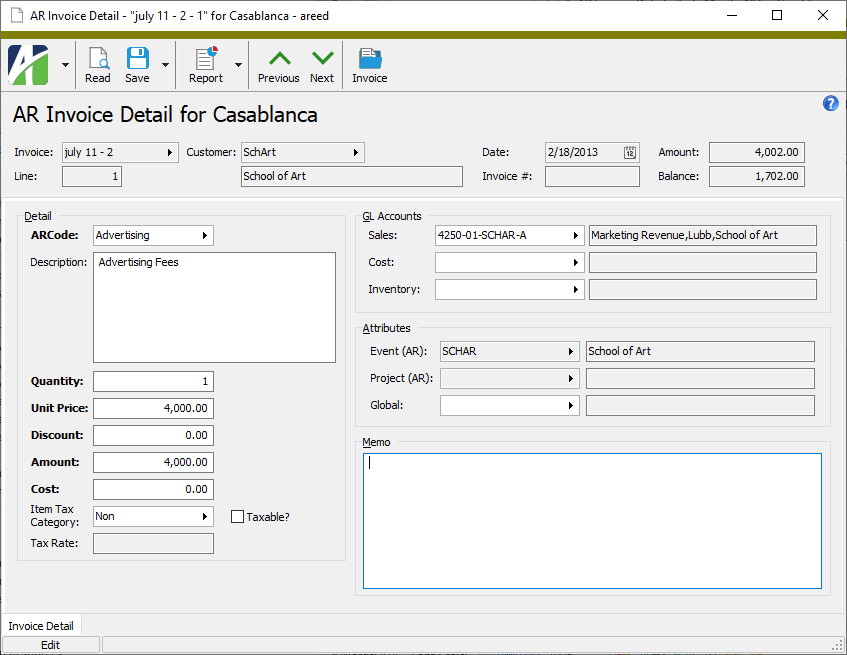
The Invoice Detail window shows the detail for an individual detail line.
You can edit the Description and Memo for any AR invoice. If the AR invoice is unmerged, you can edit all editable detail fields. If the AR invoice is merged but not merged to GL, you can edit the Description, Item Tax Category, GL Accounts, Invoice Detail Attributes, and Memo fields. If the AR invoiced is merged and merged to GL, you can edit the Description, Item Tax Category, Invoice Detail Attributes, and Memo fields. For voided or reversal invoices, you can only edit the Description and Memo fields.
The ARCode on a detail line affects the detail line in the following ways:
Categorizes the detail line for reporting purposes.
Provides masks for deriving GL account numbers for the sales, cost, and inventory accounts.
Controls whether the detail line is subject to sales tax.
Controls whether the detail line is eligible for a discount.
An invoice detail line is considered to have invalid GL if any of the following is true:
The sales account is blank or invalid.
The cost is non-zero and the cost account is blank or invalid.
The cost is non-zero and the inventory account is blank or invalid.
When you have a detail line record open, you can click to drill down to the AR invoice that contains the detail line.
Sales Analysis
AR Sales Analysis
Purpose
The Sales Analysis report helps you measure and track sales performance. Using its flexible sorting, subtotaling, and totaling options, you can use the report to analyze sales from a variety of perspectives.
Content
When the report is run showing invoice detail, for each detail line included on the report, the report shows:
invoice or GL date
invoice number
ARCode
customer code
salesperson
quantity sold
amount of sale.
(If you run the report and do not include detail, the report only shows grand totals for quantity and amount. If you do not include detail but do specify a subtotal option, the report also shows quantity and amount for each subtotal group.)
In addition, you can include information for one or more of the following:
unmerged invoices not on hold
credits
voids.
The following totals appear on the report:
subtotals (optional, by sort option)
grand totals.
Print the report
In the Navigation pane, highlight the Accounts Receivable > Invoices > Invoice Detail folder.
Start the report set-up wizard.
To report on all or a filtered subset of invoice detail records:
Right-click the Invoice Detail folder and select Select and Report > Sales Analysis from the shortcut menu.
On the Selection tab, define any filters to apply to the data.
To report on specifically selected invoice detail records:
In the HD view, select the invoice detail records to include on the report. You can use Ctrl and/or Shift selection to select multiple records.
Click .
To report on a particular invoice detail record from the Invoice Detail window:
In the HD view, locate and double-click the invoice detail record to report on. The Invoice Detail window opens with the invoice detail record loaded.
Click .
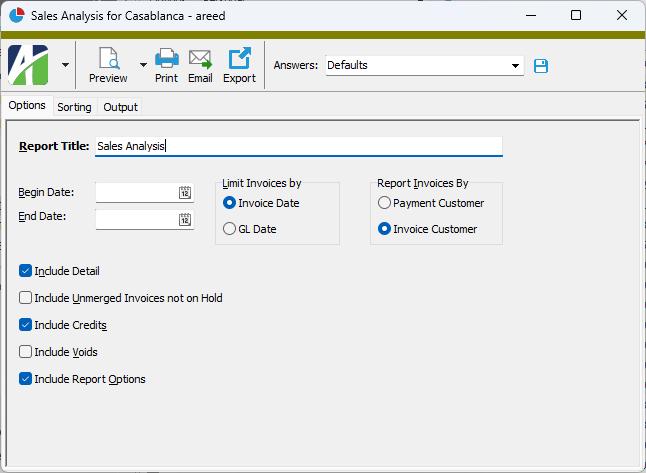
Select the Options tab.
In the Report Title field, type a title for the report. You can use up to 100 characters.
In the Begin Date and End Date fields, enter the range of dates for which to include invoice detail records on the report.
In the Limit Invoices by field, select the type of date to compare against the date range to determine which invoice detail records are included on the report. Your options are:
Invoice Date
GL Date
In the Report Invoices By field, select which customer type to reference on the report. Your options are:
Payment Customer. Use the payment customer from the customer record.
Invoice Customer. Use the customer from the invoice record.
Mark the checkbox(es) for the additional information to include:
Detail
Unmerged Invoices Not on Hold
Credits
Voids. Mark this checkbox to include voided and reversal invoices on the report. (If you use the original invoice date on reversal invoices when voiding, this option is probably not needed.) This option is most valuable when the original invoice date differs from the reversal date. Voids, reversals, and totals which include a voided and/or reversal amount are indicated by an asterisk (*).
To include a section at the end of the report with the report settings used to produce the report, leave the Include Report Options checkbox marked. To produce the report without this information, clear the checkbox.
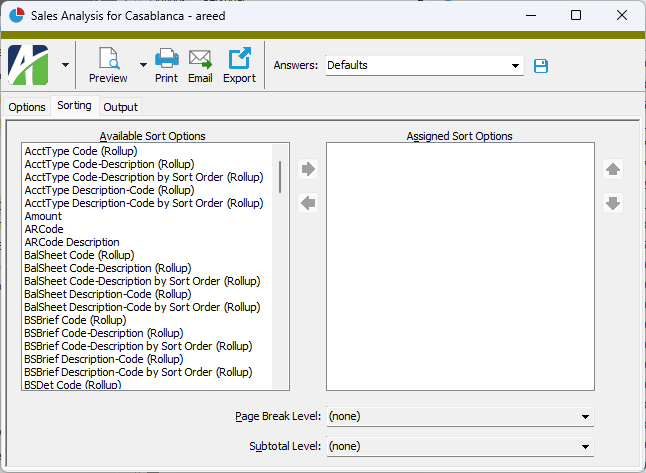
Select the Sorting tab.
In the Available Sort Options list box, highlight the field(s) to sort the report by, then click to move your selection(s) to the Assigned Sort Options list box.
If you selected multiple sort fields, use and to arrange the sort fields in the order you want them applied.
If you want the report to start a new page for each change in one of the sorting options you specified, select the sorting option to break on from the Page Break Level drop-down list. If you do not want to insert page breaks, accept "(none)".
If you want the report to subtotal based on one of the sorting options you specified, select the sorting option to subtotal on from the Subtotal Through Level drop-down list. If you do not want to show subtotals, accept "(none)".
Select the Output tab.
In the Design field, look up and select the report design to use.
In the toolbar, click the icon for the type of output you want:
- Provides access to two preview options.
Preview - Click the icon or click the drop-down arrow and select Preview from the drop-down menu to view the report in the Crystal Reports viewer.
Preview to PDF - Click the drop-down arrow next to the icon and select Preview to PDF to view the report in the PDF reader.
- Opens the Print dialog so that you can select and configure a printer and then print a paper copy of the report.
- Opens the Report Email dialog so that you can address and compose an email that the report will be attached to. For best results, ensure your email client is running before you attempt to send a report via email.
- Opens a drop-down menu with two export options:
Export Report - Opens a dialog so that you can save the report to a file. File types include Crystal Reports (.rpt), PDF (.pdf), Microsoft Excel (.xls), Microsoft Word (.doc), rich text (.rtf), and XML (.xml).
Export Data - Opens a dialog so that you can export report data to XML or JSON file format.
From
The email account from which to send the email. Valid options are:
Windows user default account. Sends email using the user's Windows default email account. For most users, this is the account configured in Outlook or another email client application.
Server personal. Sends email using the email configuration for the system or company server and the email address on the current user's authorized user record. The authorized user record must have a confirmed email address.
Server generic. Sends email using the email configuration and "from" address for the system or company server. This option requires "Send generic" access to the Server Email resource.
To
The email address(es) to which to send the email. Separate email addresses with semi-colons.
CC
The email addresses to copy on the email. Separate email addresses with semi-colons.
BCC
The email addresses to blind copy on the email. Separate email addresses with semi-colons.
Subject
The subject line.
Text box
The body of the email.
Data extensions
The following data extensions are available for the report:
Customers
Invoices
Invoice detail
Summary invoices
Invoice Detail Record ID
Invoice
Displays the batch name and entry number of the invoice that contains the detail line.
Press F3 to look up the value.
If a value is already selected, you can press F4 to open the record in its native editor.
Line
Displays the number of the detail line.
Customer
Displays the customer associated with the invoice that contains the detail line.
Press F3 to look up the value.
If a value is already selected, you can press F4 to open the record in its native editor.
Date
Displays the invoice date on the invoice that contains the detail line.
Invoice #
Displays the invoice number of the invoice that contains the detail line.
Amount
Displays the amount of the invoice that contains the detail line.
Balance
Displays the remaining balance on the invoice that contains the detail line.
Invoice Detail tab
Detail
ARCode
The ARCode assigned to the detail line. This field is disabled if the invoice is merged.
Press F3 to look up the value.
If a value is already selected, you can press F4 to open the record in its native editor.
Description
The detail line description. This field is always available for editing.
Quantity
The quantity sold for the detail line. This field is disabled if the invoice is merged.
Unit Price
The unit price of the item sold. This field is disabled if the invoice is merged.
Discount
The discount amount for the detail line. This field is disabled if the invoice is merged.
Amount
The extended amount for the detail line. This field is disabled if the invoice is merged.
Cost
The cost for the detail line. This field is disabled if the invoice is merged.
Item Tax Category
The item tax category assigned to the detail line. This field is disabled on voided or reversal invoices.
Press F3 to look up the value.
If a value is already selected, you can press F4 to open the record in its native editor.
Taxable?
Indicates if the invoice detail line is taxable. This checkbox is always disabled.
Tax Rate
The tax rate applied to the invoice detail line. This field is always disabled.
GL Accounts
This section shows the GL accounts used to post the GL entry for the invoice detail line. If an account is not fully qualified or if the account does not exist, the background is shaded yellow. Before the GL entry can be posted, a valid account must be entered. If a valid account number is changed to a different valid account number, the account number displays in purple.
Sales
The sales account used for the invoice detail line. This field is disabled if the GL entry is merged.
Press F2 to open the Account Expand dialog box where you can look up an account number, find an account number by its alias, build the account number by segment, or view setup and setup sources.
Press F3 to look up the account.
If an account is already selected, you can press F4 to open the record in the Account window.
Cost
The cost account used for the invoice detail line. This field is disabled if the GL entry is merged.
Press F2 to open the Account Expand dialog box where you can look up an account number, find an account number by its alias, build the account number by segment, or view setup and setup sources.
Press F3 to look up the account.
If an account is already selected, you can press F4 to open the record in the Account window.
Inventory
The inventory account used for the invoice detail line. This field is disabled if the GL entry is merged.
Press F2 to open the Account Expand dialog box where you can look up an account number, find an account number by its alias, build the account number by segment, or view setup and setup sources.
Press F3 to look up the account.
If an account is already selected, you can press F4 to open the record in the Account window.
Attributes
One field, labeled with the attribute name, appears in this section for each active attribute with AR invoice detail usage.
[Attribute Name]
An attribute item that applies for the invoice detail line. If the attribute is a required attribute, you must select an attribute item. If the attribute is also enabled for AR invoice usage, this field defaults to the attribute used on the invoice, if applicable. Overriding the default attribute will cause the new value to display in purple.
Attribute items provide additional ways to categorize invoice detail lines for reporting and they can contribute to the GL account masks used to derive the GL accounts used during invoice posting.
You can change an attribute item on a merged invoice; however, related changes to GL accounts only occur if the account was not manually entered and the associated GL entry is not merged.
Press F3 to look up the value.
If a value is already selected, you can press F4 to open the record in its native editor.
Memo
Additional descriptive information about the invoice detail line. This field is always available for editing.
Invoice detail security
Common accesses available on invoice detail
Access
A user with this access can...
Change
Use the mass change action on invoice detail.
Data
Have read-only access to invoice detail from anywhere in the software (e.g., field validations, filters, date expressions).
Delete
Delete invoice detail.
Edit
Edit invoice detail records.
Read
Have read-only access to invoice detail records.
Report
Run reports with invoice detail information.
Report Designs
Create and edit report designs with invoice detail information. This access enables the Report Designs button on the Output tab of report dialogs.
Shared Answers
Create and edit saved answers related to invoice detail.
Shared Filters
Create and edit shared filters on invoice detail.
Visible
View the Invoice Detail folder in the Navigation pane.
Invoice detail filters
The following built-in filters are available for invoice detail records:
Filter Name
Effect
? Amount
Prompts for a range of amounts and lists the invoice detail records with an amount in that range.
? ARCode
Prompts for an ARCode and lists the invoice detail records with an ARCode that contains the specified search string.
? Customer Class
Prompts for a customer class and lists the invoice detail records for customers with a class code that contains the specified search string.
? Customer Code
Prompts for a customer code and lists the invoice detail records for customers with a customer code that contains the specified search string.
? Customer Name
Prompts for a customer name and lists the invoice detail records for customers with a name that contains the specified search string.
? Invoice Date
Prompts for a range of dates and lists the invoice detail records with an invoice date in that range.
? Sales Account
Prompts for a sales account number and lists the invoice detail records with a sales account that contains the specified search string.
? Sales Account Mask
Prompts for a sales account mask and lists the invoice detail records with a sales account that matches the specified account mask.
? Tax Category (Item)
Prompts for an item tax category and lists the invoice detail records with an item tax category that contains the specified search string.
Has Invalid GL
Lists invoice detail records with general ledger problems.
 to drill down to the AR invoice that contains the detail line.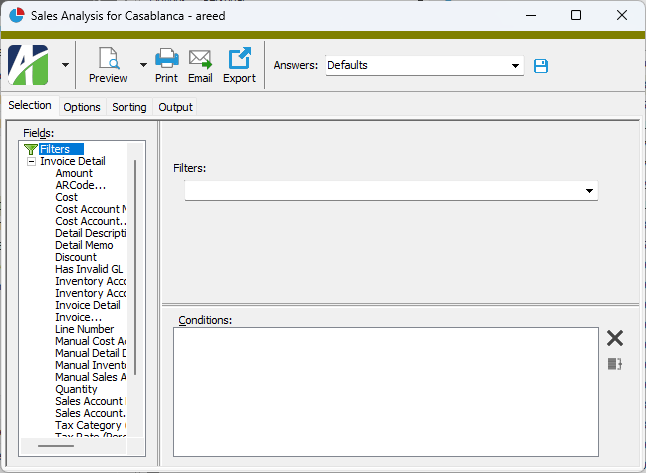
 .
.
 to move your selection(s) to the Assigned Sort Options list box.
 and
and  to arrange the sort fields in the order you want them applied.
 - Provides access to two preview options.
 - Opens the Print dialog so that you can select and configure a printer and then print a paper copy of the report.
 - Opens the
  - Opens a drop-down menu with two export options: