Tax Entity Record ID
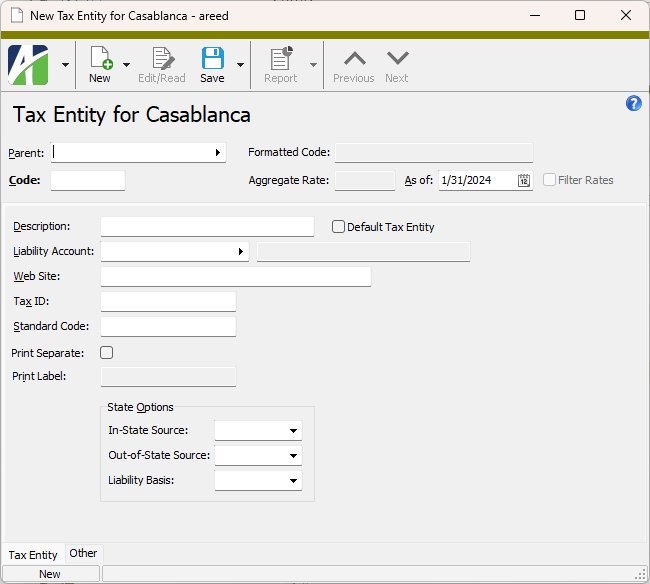
Parent
The immediate parent tax entity of this tax entity. If this is a top-level (federal) tax entity, you can leave this field blank.
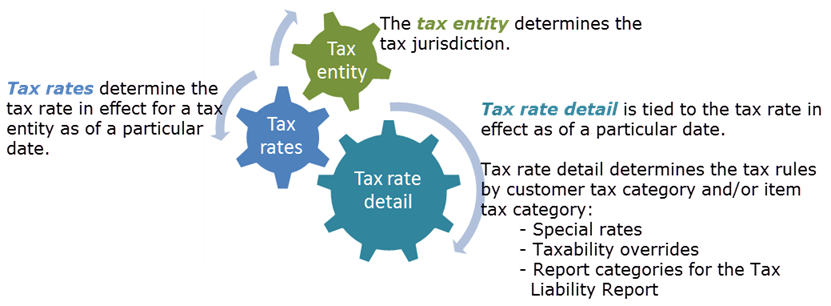
The structure of AR tax entities is hierarchical. Each tax entity, except for top-level tax entities, has exactly one immediate parent tax entity. Top-level tax entities do not have a parent entity and typically represent federal tax entities. Although the USA does not currently have a federal sales tax, the "U" entity is the built-in top-level tax entity for the USA. All state-level tax entities for the USA are required to have "U" as their immediate parent. As implied, state (or province) tax entities are at the second level of the hierarchy. You can have up to eight additional levels of tax jurisdictions in the hierarchy structure representing entities such as counties, cities, transportation districts, SPDs, and MTAs.
Press F3 to look up the value.
If a value is already selected, you can press F4 to open the record in its native editor.
Code
A code for the tax entity; the shorter, the better. The parent code joined to the tax entity code must be unique.
Tip
For states or provinces, consider using the two-character postal abbreviation as the code.
Formatted Code
This field displays the complete identifier for the tax entity, the parent code combined with the current tax entity's code.
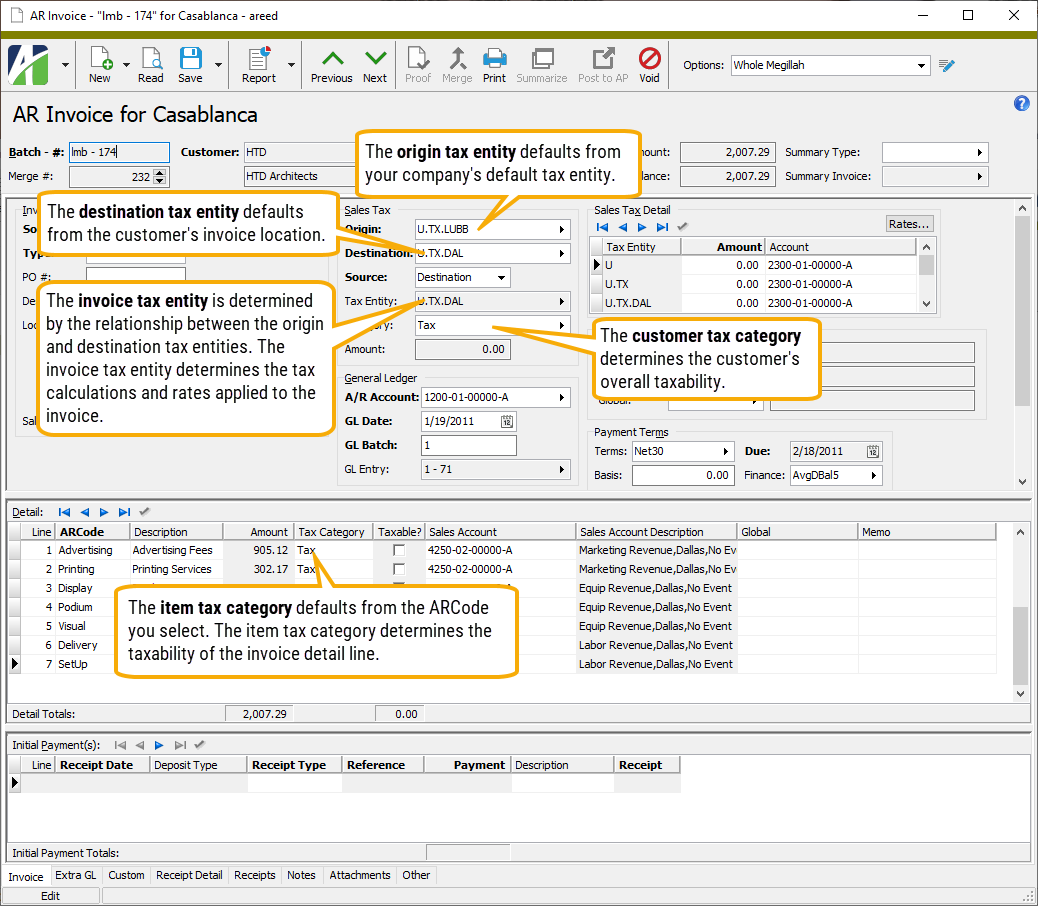
The formatted tax entity code is derived by concatenating the immediate parent entity code with a period and then with the code for the immediate jurisdiction. So, the state code for Texas is "U" + "." + "TX" = U.TX. The county code for Dallas County might be "U.TX" + "." + "DAL" = U.TX.DAL.
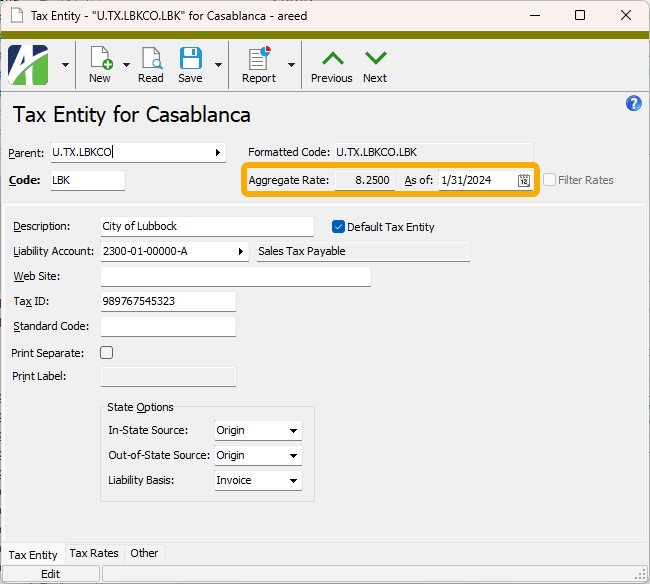
Aggregate Rate
This field displays the total effective tax rate for the tax entity and all tax entities above it in its hierarchy. The aggregate rate is given with respect to the date you specify in the As of field. The default aggregate rate is the rate as of today. This field is for investigational purposes only; changes to the As of date and the Aggregate Rate are not saved when the tax entity record is saved.
Example
| U | United States | 0.0000% |
| TX | State of Texas | 6.2500% |
| DAL | Dallas County, Texas | 1.0000% |
| MTA | Dallas MTA Transit | 1.0000% |
The date as of which to calculate the aggregate rate for the entity. The default date is today's date. Change the date in this field to see the aggregate rates on other dates. This field is for investigational purposes only; changes to the As of date and the Aggregate Rate are not saved when the tax entity record is saved.
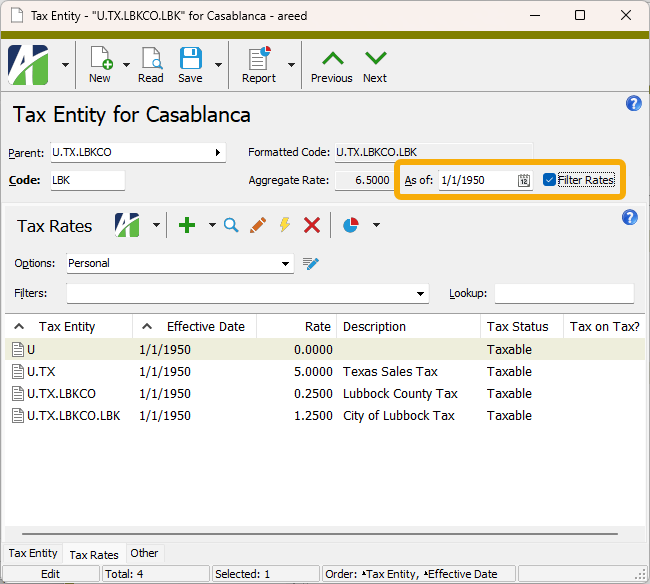
When you view the Tax Rates tab, you can use this field in conjunction with the Filter Rates checkbox to only show the tax rates that contribute to the aggregate rate as of the date you enter.
Filter Rates
This checkbox is enabled when you select the Tax Rates tab. Mark this checkbox to filter the Tax Rates pane to show only the tax rates that contribute to the aggregate rate as of the date in the As of field. If you do not mark the checkbox, the Tax Rates pane shows all tax rates defined for the current tax entity and the entities above it in its hierarchy.
Tax Entity tab
Description
A description of the tax entity.
Default Tax Entity
If this checkbox is marked, the tax entity represents the tax jurisdiction for the primary location where your organization originates sales. Marking this checkbox causes the tax entity to be loaded as the default origin tax entity on all new invoices.
Liability Account
The GL account mask for the tax liability account to use for the tax entity. If you want the tax entity to inherit the liability account from its parent tax entity, leave this field blank.
Example
If you have separate tax liability accounts for each state, enter a liability account on each state tax entity. All tax entities below the state tax entity in the hierarchy automatically use their state's tax liability account. If you have separate tax liability accounts by operating unit (such as store, division, or unit), enter wildcards in that part of the tax liability account mask. Wildcards can be replaced with the corresponding characters from the sales tax liability account masks from attributes with AR usage at invoice entry time.
Press F2 to open the Account Expand dialog box where you can look up an account number, find an account number by its alias, build the account number by segment, or view setup and setup sources.
Press F3 to look up the account.
If an account is already selected, you can press F4 to open the record in the Account window.
Web Site
The URL of the tax entity's website. The entry becomes a hyperlink that you can use to open the web page by pressing Ctrl+click.
Tax ID
The tax identification number assigned to your company by the tax entity. The tax ID is for reporting purposes only.
Standard Code
The standard code or description defined by the taxing authority to identify the tax entities (counties, cities, municipalities, SPDs, MTAs, etc.) that need to report tax information.
Print Separate
If this checkbox is marked, indicates the tax entity's amount should print on a separate line on invoices.
Print Label
This field is enabled if you mark the Print Separate checkbox. Enter the label to print next to the tax entity's amounts on invoices. You can use up to 20 characters for the label.
State Options
In-State Source
The default tax entity source for an invoice when this tax entity is used as the destination tax entity and both the origin and destination tax entities are in the same state (or province). Your options are:
- Origin. Use the origin tax entity on the invoice as the tax entity for calculating tax on the invoice.
- Destination. Use the destination tax entity on the invoice as the tax entity for calculating tax on the invoice.
Out-of-State Source
The default tax entity source for an invoice when this tax entity is used as the destination tax entity and the origin and destination tax entities are from different states (or provinces). Your options are:
- Origin. Use the origin tax entity on the invoice as the tax entity for calculating tax on the invoice.
- Destination. Use the destination tax entity on the invoice as the tax entity for calculating tax on the invoice.
Liability Basis
The basis for determining tax liability for the tax entity. (The Tax Liability Report lets you limit the tax entities by liability basis.) Your options are:
- Invoice (accrual)
- Receipt (cash)
Custom tab
This tab is visible if custom fields exist for the entity. At a minimum, if there are custom fields, a Fields subtab will be present. One or more additional categories of subtabs may also be visible.
Fields subtab
This tab prompts for values for any custom fields set up for entity records of this entity type. Respond to the prompts as appropriate.
References subtab
This tab is visible if other records reference the current record.
Reference
From the drop-down list, select the custom field to view references for. Reference custom fields have the following format: PackageName.EntityName.CustomFieldName.
Example
Suppose a custom field exists on PRCodes that references an ARCode. On the ARCode record, on the Custom > References subtab, you can view all the PRCodes which reference that ARCode.
Exchange Folder subtab
This tab is visible only if you set up a custom field with a data type of "Exchange Folder". The label on this tab is the name assigned to the custom field.
This tab shows the contents of the specified Exchange folder.
File subtab
This tab is visible only if you set up a custom field with a data type of "File". The label on the tab is the name assigned to the custom field.
This tab renders the contents of the specified file according to its file type.
Internet Address subtab
This tab is visible only if you set up a custom field with a data type of "Internet Address". The label on this tab is the name assigned to the custom field.
This tab shows the contents of the specified web page.
Network Folder subtab
This tab is visible only if you set up a custom field with a data type of "Network Folder". The label on this tab is the name assigned to the custom field.
This tab shows the contents of the specified network folder.
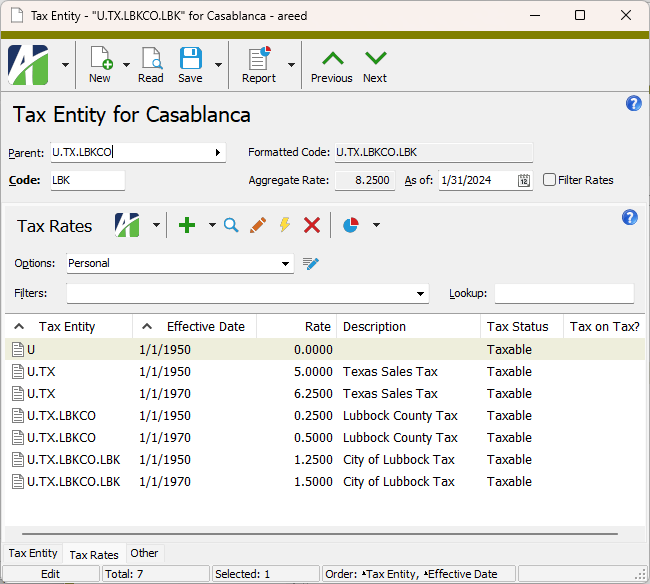
Tax Rates tab
The Tax Rates pane shows the Tax Rates HD view filtered to show the tax rates for the selected tax entity. You can enter an effective date in the As of field and mark the Filter Rates checkbox above this pane to show only the tax rates that contributed to the aggregate rate as of the effective date.
Double-click a row in the pane to drill down to its record in the Tax Rate window.
The Attachments tab is visible if any record for a given entity has an attachment. If the Attachments tab is not visible, this implies that no record of the entity type has an attachment on it; however, once an attachment is added to any record of the entity type, the Attachments tab will become available.
Attachments
The list box shows the files which are attached to the current record. Highlight a file name to preview the file in the adjacent pane. Double-click a file name to open the file in its native editor.
Preview pane
If a file name is highlighted in the Attachments list box, this pane shows a preview of the file contents. Some file types cannot be previewed but can be double-clicked to open in their native editor.
Change Logs tab
This tab is visible if the user has "Change Logs" access to the associated data folder resource.
The Change Logs pane shows the Change Logs HD view filtered to show all change logs for the selected entity record.
Double-click a row in the pane to drill down to its record in the Change Log window.
Other tab
Memo tab
To include additional information about this record not collected elsewhere, enter it in this text box. This area supports common keyboard shortcuts such as Ctrl+C to copy and Ctrl+V to paste.
Timestamps tab
This tab shows the user who created this record and the date and time of creation as well as the user, date, and time of the latest modification to the record.
Developer tab
This tab is visible only when developer features are enabled.
Automation subtab
This subtab shows field names and values for the current data record. Use the information in the subtab to assist when creating automation objects such as bots and import files. The field names and field values can be copied from the text box and pasted directly into your code or application. To copy content from the text box, highlight the content to copy and press Ctrl+C or right-click your selection and select Copy from the context menu.
Export (XML | JSON) subtab
This subtab shows the XML syntax for exporting the selected data record. The syntax can be copied from the text box as an exemplar for creating your own automation objects for bots, import files, ActivWebAPI, etc. To copy content from the text box, highlight the content to copy and press Ctrl+C or right-click your selection and select Copy from the context menu.
Import (XML | JSON) subtab
This subtab allows you to select a file for import and shows the XML syntax for importing data records. Use the subtab to explore the XML syntax for importing data records. In particular, you can investigate the syntax which results when using Data.Import and ActivWebAPI data POST and DELETE routes.
Change Log (XML | JSON) subtab
This subtab is visible only when the Enable Change Logs option is marked in System Options or Company Options (depending on whether the feature applies at the system or the company level). This is the default setting when developer features are enabled.
This subtab allows you to investigate changes to the current data record. The syntax can be copied for use in bots, dashboards, ActivWebAPI, and other automation. To copy content from the text box, highlight the content to copy and press Ctrl+C or right-click your selection and select Copy from the context menu.
Select Statement (SQL) subtab
This subtab allows you to investigate the SQL select statement used to retrieve the current data record. The syntax can be copied as an exemplar for data sources and other automation. To copy content from the text box, highlight the content to copy and press Ctrl+C or right-click your selection and select Copy from the context menu.
 Supported sales tax calculations
 . The New Tax Entity window opens.